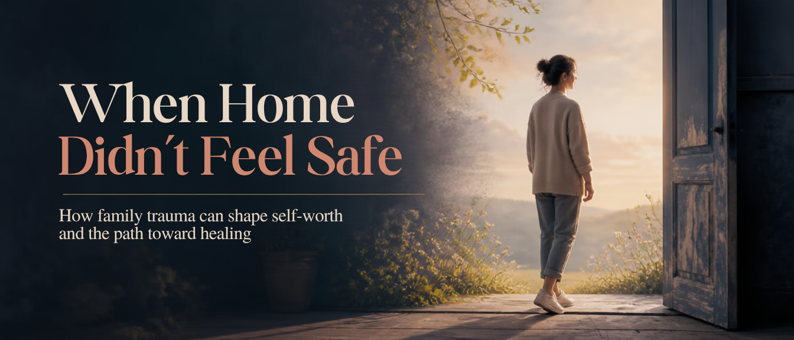
What happens to your sense of worth when home is the place where you first learn what love is supposed to feel like—but criticism, silence, control or unpredictability keep interrupting the lesson?
Growing up around emotional invalidation, conditional affection, fear-based control or neglect can shape the way a child understands themselves and other people. These experiences do not affect everyone in the same way, but they can leave a person working hard to feel safe, acceptable or worthy long after childhood has ended.
This is not a story about blaming yourself for the ways you learned to cope. It is an invitation to understand those patterns with care, make room for more accurate beliefs and consider what support might help now.
A trauma-informed starting point: A coping pattern may once have helped you get through a difficult environment. Understanding its purpose can be more useful than judging yourself for having it.
How FamilyPatterns can become Beliefs about Worth
Children depend on adults for care, protection and a sense of belonging. When approval is tied to obedience or performance, when feelings are mocked or dismissed, or when household rules change with an adult’s mood, children may adapt by studying the environment closely and adjusting themselves to it.
Fear-based control can teach a child that disagreement is dangerous. Inconsistency can make affection feel unpredictable. Repeated criticism can turn ordinary mistakes into evidence of supposed inadequacy. None of these responses proves that the child is unworthy; they show how powerfully children try to create meaning from the conditions around them.
Message a Child may Absorb
Possible Adult Echo
“Approval depends on getting everything right.”
You may measure your value by productivity, achievement or usefulness.
“My feelings make life harder for other people.”
You may minimise needs, apologise for having emotions or avoid asking for help.
“The mood in the room is my responsibility.”
You may monitor everyone else while losing touch with your own experience.
“Closeness can disappear without warning.”
You may work hard to prevent rejection or expect relationships to change suddenly.
The adults held responsibility for creating a safe, respectful environment. A child cannot be responsible for a parent’s emotional regulation, choices or capacity to respond with care.
The inner critic is often a learned alarm
When criticism, shame or comparison is repeated, the words can become part of a person’s private soundtrack. The resulting inner voice may sound like a demand to be flawless, a warning not to disappoint anyone or a prediction that one mistake will lead to rejection.
This internalised critic can feel personal because it speaks from inside your own mind. Yet its presence does not mean its message is true. It may reflect old rules that were formed when belonging and safety depended on reading other people accurately.
In adulthood, this can show up as self-doubt, perfectionism, fear of abandonment, difficulty trusting praise or a tendency to dismiss achievements. Some people also notice emotional reactions that feel larger or faster than they expect, or self-sabotaging choices that protect them from the vulnerability of hoping for something better. These experiences can have many causes, and they are not proof of a particular diagnosis.
A gentler question: Instead of asking, “What is wrong with me?” try asking, “What expectation am I carrying, and where might I have learned it?” Curiosity can create a little distance from a belief without denying how painful it feels.

Hypervigilance can Follow You into Adult Relationships
In an unpredictable home, paying close attention to footsteps, facial expressions, silence and changes in tone may have helped a child anticipate what came next. People-pleasing can serve a similar purpose: keeping others comfortable may have seemed safer than expressing a need or setting a limit.
Later, these adaptations can remain active even when the current situation is less threatening. A person may find themselves:
- Scanning for danger in neutral pauses, messages or changes in someone’s mood
- Overexplaining or appeasing to prevent conflict, disappointment or withdrawal
- Struggling to trust consistency because closeness once felt uncertain
- Reacting intensely to criticism or becoming emotionally overwhelmed during disagreements
- Repeating familiar dynamics or pulling away when a relationship begins to feel vulnerable
These patterns are understandable attempts to manage uncertainty, not character flaws. They are also not fixed outcomes. With time, reflection and support, a person may learn to distinguish present-day information from an old alarm. Relationships can be an important part of that learning when they include mutual respect, steadiness and room for honest needs.
When Practical Care is Present but Emotional Care is Missing
Emotional neglect is often difficult to recognise because it may involve an absence rather than an obvious event. A child may have food, clothing, housing and school support while still lacking comfort, curiosity, encouragement or a reliable response to distress.
Practical care and emotional responsiveness are related, but they are not identical. Practical care meets important physical needs; emotional responsiveness helps a child feel known, supported and safe enough to develop an inner sense of worth.
Practical care
Emotional responsiveness
Providing meals, clothing, shelter and transport
Noticing distress and offering comfort or reassurance
Arranging school, medical or everyday responsibilities
Listening to feelings without ridicule or immediate dismissal
Celebrating visible achievements
Showing interest in the child’s inner world, effort and ordinary moments
Celebrating visible achievements
Showing interest in the child’s inner world, effort and ordinary moments
This distinction is not meant to flatten complicated families or erase the care that was present. It helps explain why someone can feel grateful for what they received and still carry pain about what was unavailable. A child who was not emotionally met may grow up feeling unseen, difficult to love or unsure how to recognise and express needs.
Healing means Building a Safer Relationship with Yourself
Healing does not require proving that your past was “bad enough,” blaming every present difficulty on childhood or becoming perfectly calm. It can begin with noticing what happened, what you learned from it and what you would like to practise now.
- Name the pattern. Describe the behaviour plainly—such as criticism, withdrawal, emotional dismissal or pressure to keep everyone happy—without minimising its effect.
- Practise self-compassion. Speak to yourself as someone who adapted under pressure, while still taking responsibility for choices you make in the present.
- Identify needs and feelings. Pause to ask what you are experiencing, what matters to you and what kind of response would feel respectful.
- Build boundaries gradually. Start with a limit you can communicate and maintain safely; a boundary is information about what you will do, not a demand that another person change instantly.
- Seek consistent relationships. Notice people who respect consent, repair harm, keep reasonable commitments and make room for your full range of feelings.
- Consider professional support. A trauma-informed mental health professional can help you explore relational patterns, emotional regulation and self-worth at a pace that fits your circumstances.
Progress may include moving forward, pausing, revisiting old feelings and trying again. A slower period does not erase the work you have done.
Small practice
When the critical voice appears, write down its prediction, the evidence it is using and one kinder, more present-focused response. The goal is not forced positivity; it is making room for a fuller view.
Your Worth can Become Yours Again
The ways you learned to survive a difficult family environment may have shaped your relationships, self-talk and expectations, but they do not have to define your future. You can begin replacing inherited rules with experiences of steadiness, choice, mutual care and respect.
Support can make that process less solitary. Consider sharing one pattern you have noticed with a trusted person or trauma-informed professional, then choose one small act of care or one manageable boundary to practise this week. Recovery is not a straight line, and needing support again does not mean you have failed.
You were not responsible for the conditions that taught you to doubt yourself. If you or someone with you is currently unsafe, seek immediate help from local emergency services, a local crisis line or a local domestic-violence support service. Your safety matters, and your worth is not something you need to earn.
DISCLAIMER
This article is for general education and reflection. It is not a diagnosis, a clinical assessment, or a replacement for professional support. If you are dealing with ongoing danger, abuse, severe distress, or thoughts of harming yourself or someone else, seek immediate help from local emergency services or a qualified support professional.
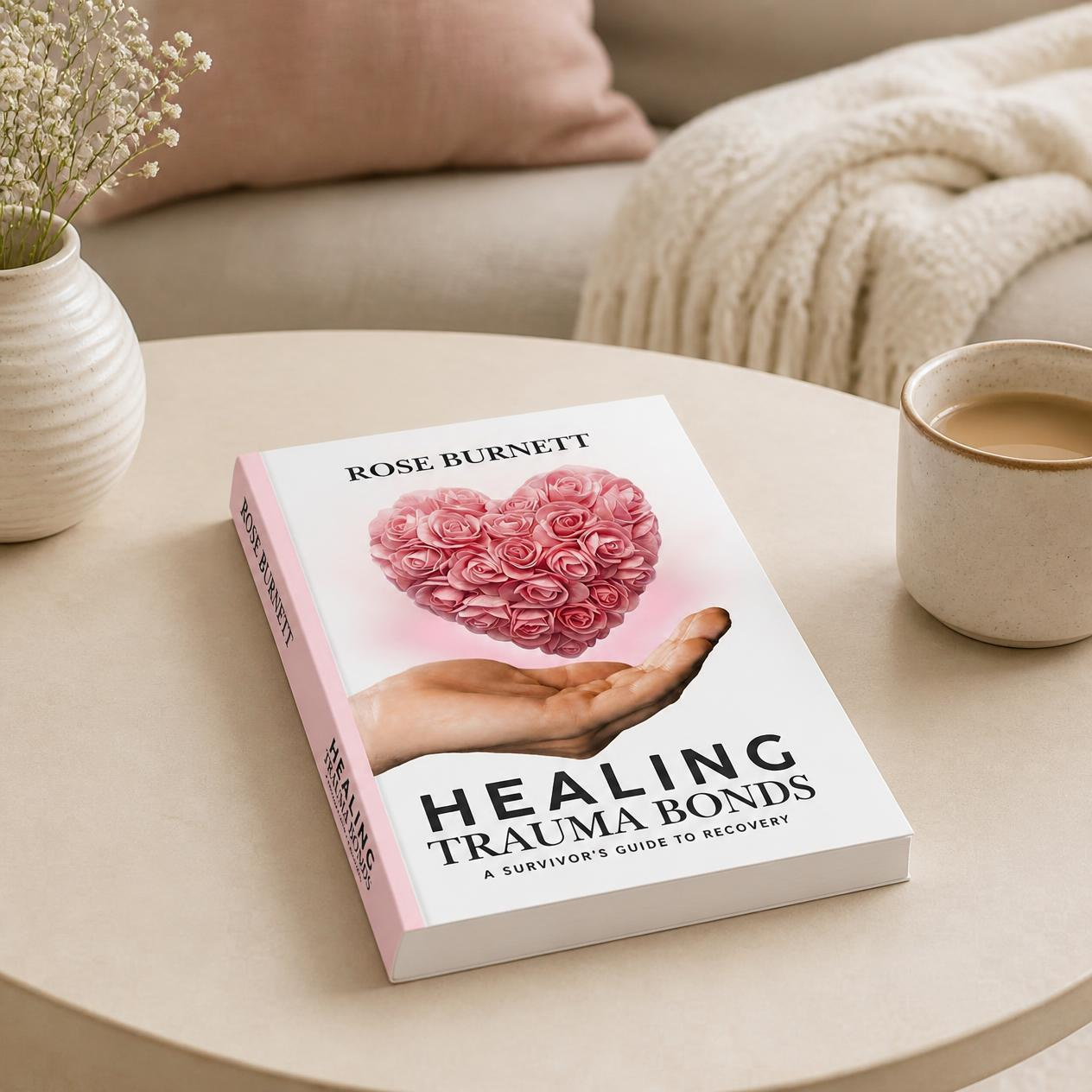
Healing Trauma Bonds: A Survivors Guide to Recovery
Based on a true story, this powerful book explores growing up in a dysfunctional family system and the lasting impact of childhood trauma. It reveals how early pain can shape our identity, self-worth, and the patterns that keep us trapped in trauma bonds. Honest and deeply personal, it speaks to anyone seeking understanding, healing, and freedom.
Available on Amazon in All Countries and Currencies. Choose your local Amazon platform for the best pricing on shipping and postage. Search using ASIN Number: B0HNR4H6XK

ABOUT THE AUTHOR
Rose Burnett is a Certified Transformational Coach, NLP practitioner, Advanced Reiki Practitioner, Psychic Medium and Author with more than 14 years’ experience in mindset coaching. Through her work in inner-child healing, family systems, trauma recovery, mind-body-soul balance, lifestyle coaching and psychic development, she helps people move towards greater awareness, self-discovery and inner growth. Her mission is to support others as they heal, reconnect with themselves and create more balanced, authentic lives.